EU Life Expectancy Post-COVID-19
Sep 15, 2025
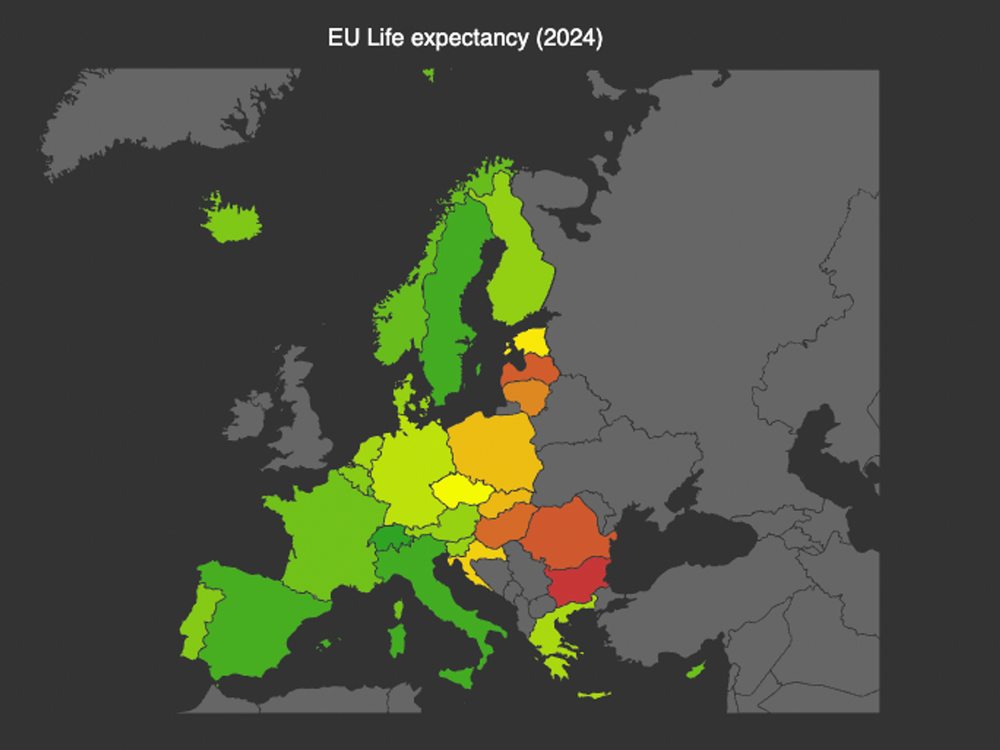 According to some data published recently by Eurostat, life expectancy at birth in the European Union climbed to 81.7 years in 2024, an increase of 0.3 years compared with 2023.
The figures show a notable differences across member states. Italy and Sweden are at the top of the rankings at 84.1 years, followed by Spain at 84.0 years. At the other end of the spectrum, Bulgaria (75.9), Romania (76.6) and Latvia (76.7) recorded the lowest life expectancy.
It's inteesting how most countries have now surpassed their pre-pandemic levels. Of the 26 EU countries with available data, 24 saw improvements between 2019 and 2024. The biggest gains were observed in Lithuania (+1.1 years), Czechia, Latvia and Romania (+1.0 each).
This 2024 results suggest that many EU countries have not only recovered from the setbacks of the COVID-19 pandemic but are continuing to make gradual progress in public health and longevity.
Life expectancy in Europe 2022
Oct 26, 2024
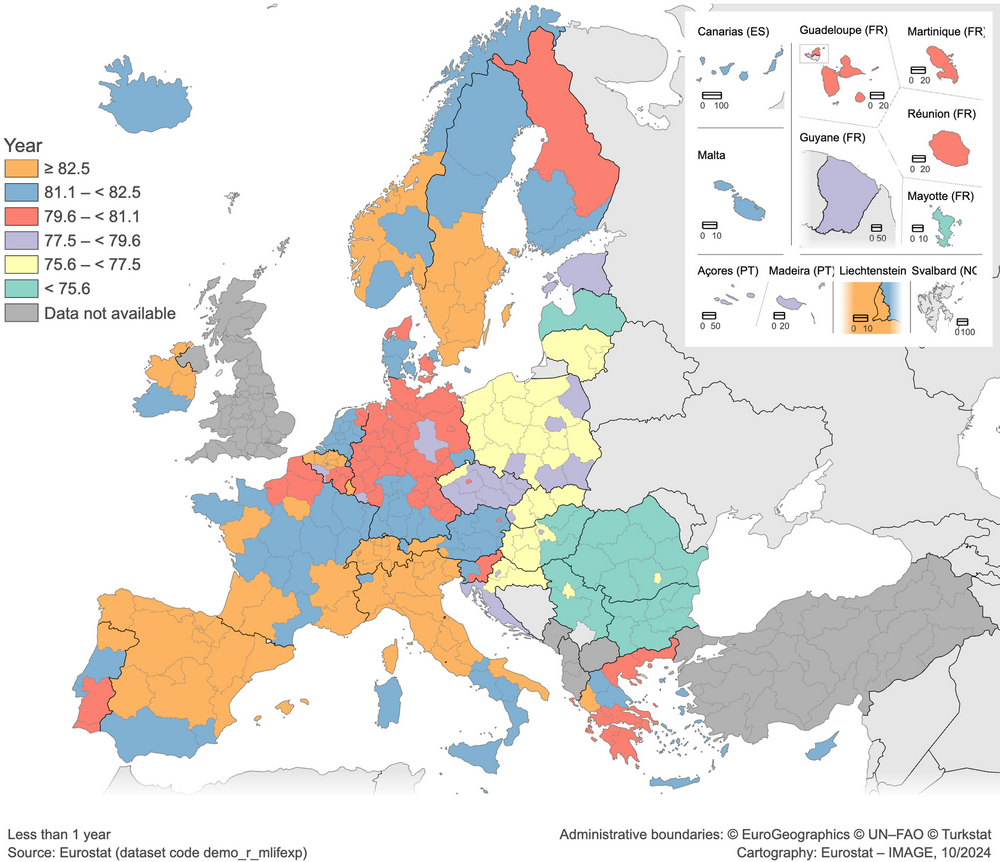 Europe's Eurostat ( European Statistical Office ), offers a really useful tool called IMAGE, which allows users to create professional thematic maps using NUTS (Nomenclature of Territorial Units for Statistics) boundaries and statistical regions. The tool is user-friendly and offers a wide range of customization options, including color schemes, data classification methods, and labels.
Using this tool, I created the image above, highlighting stark contrasts in life expectancy across European regions. Switzerland and Spain lead with impressive numbers, with some Spanish regions reaching a life expectancy of up to 85.2 years. Swiss citizens also enjoy longevity, with most regions reporting life expectancies between 83 and 84.6 years. In contrast, Bulgaria presents a different picture, with life expectancy as low as 72.3 years in some regions – revealing a gap of nearly 13 years compared to the highest in Europe.
Even within countries, significant variations exist. Take Belgium, where life expectancy ranges from 79.2 to 83.2 years across different regions. Germany shows similar regional disparities. The map also highlights the relatively low life expectancy in Eastern Europe, with most regions in Romania, Bulgaria, and Hungary reporting figures below 75 years.
Europe's Eurostat ( European Statistical Office ), offers a really useful tool called IMAGE, which allows users to create professional thematic maps using NUTS (Nomenclature of Territorial Units for Statistics) boundaries and statistical regions. The tool is user-friendly and offers a wide range of customization options, including color schemes, data classification methods, and labels.
Using this tool, I created the image above, highlighting stark contrasts in life expectancy across European regions. Switzerland and Spain lead with impressive numbers, with some Spanish regions reaching a life expectancy of up to 85.2 years. Swiss citizens also enjoy longevity, with most regions reporting life expectancies between 83 and 84.6 years. In contrast, Bulgaria presents a different picture, with life expectancy as low as 72.3 years in some regions – revealing a gap of nearly 13 years compared to the highest in Europe.
Even within countries, significant variations exist. Take Belgium, where life expectancy ranges from 79.2 to 83.2 years across different regions. Germany shows similar regional disparities. The map also highlights the relatively low life expectancy in Eastern Europe, with most regions in Romania, Bulgaria, and Hungary reporting figures below 75 years.Happy St. Patricks Day 2024
Mar 17, 2024
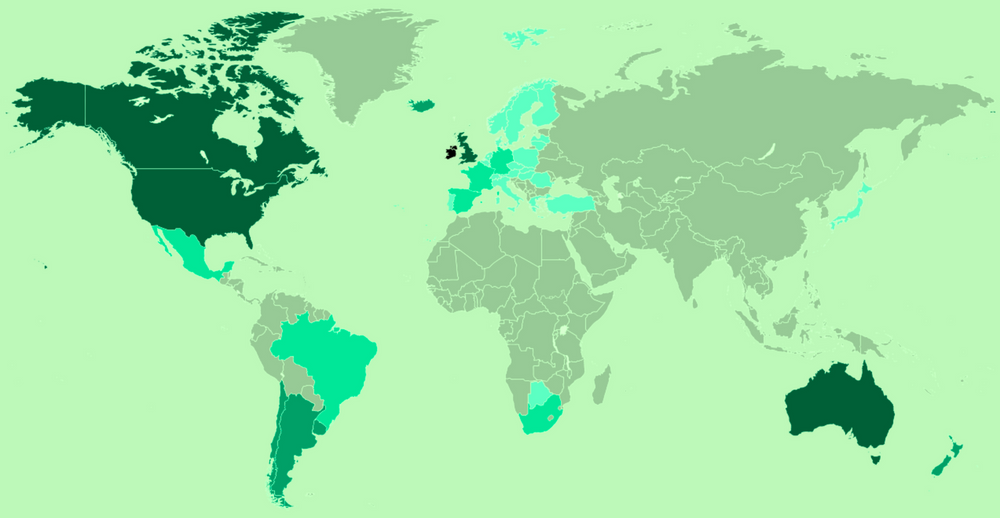
According to wikipedia, the Irish population is approximately 6.9 million, but the Irish diaspora is estimated to include 50 to 80 million people worldwide, making it one of the largest of any nation.
Historical factors such as conflict, famine, and economic hardships have spurred emigration from Ireland. People of Irish descent are predominantly found in English-speaking nations, notably Great Britain, the United States, Canada, New Zealand, and Australia.
Some significant Irish communities also exist in Argentina, Mexico, Brazil, Germany, and The United Arab Emirates, but the United States hosts the largest population of Irish descent, while Australia boasts the highest percentage of Irish descendants outside of Ireland.
To all of you, my fellow Irish men and women, whether you reside within the shores of the emerald island or beyond, I wish you a happy St. Patrick's Day in 2024!
Life expectancy in Europe
Sep 30, 2020
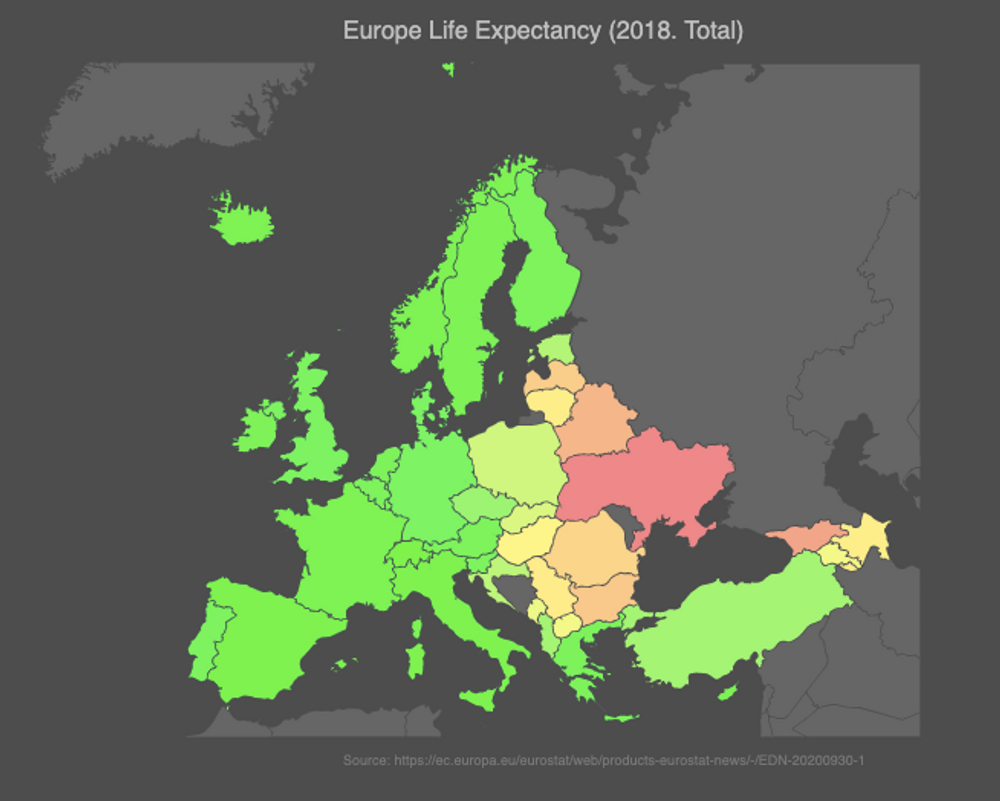
A friend of mine who works at the European Union, shared an interesting articule about the Life Expectancy in the different EU regions.
The last data available from 2018, shows that Swtizerland (83.8), Spain (83.5) and Italy (83.4) had the highest life expectancy, as you can see on the map above.