
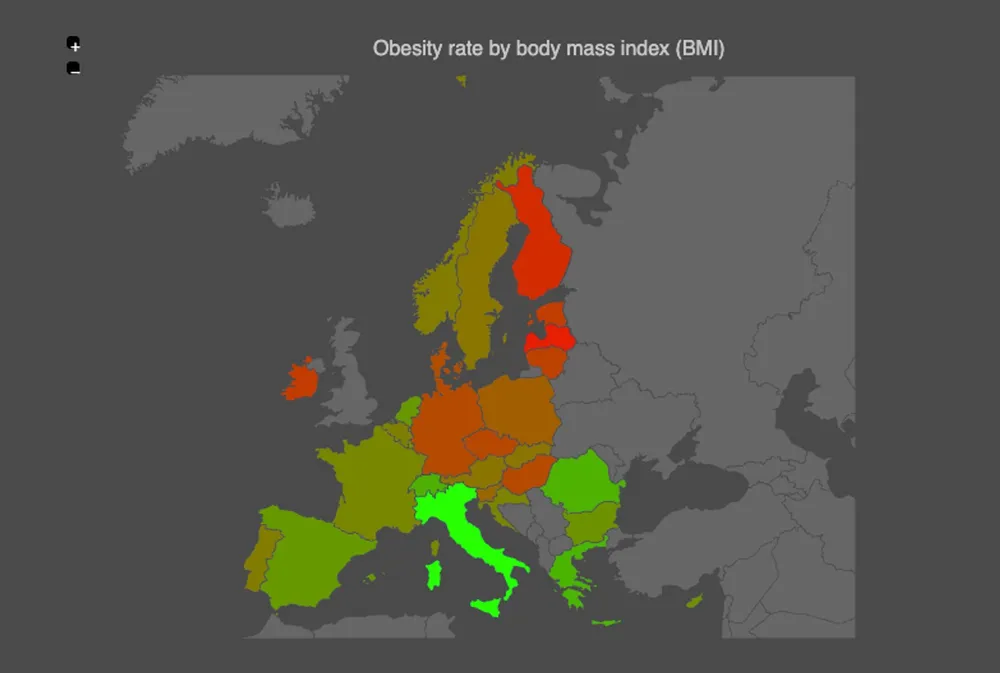
The latest EU statistics from Eurostat paint a worrying picture of obesity rates on the continent. As of 2025, 16.3% of EU adults are classified as obese (BMI of 30 or higher), and a further 35.4% fall into the “pre-obese” category (BMI 25–30).
Add those two together and you get more than half of the adult EU population currently carrying excess weight.
There’s also a clear gender split in the numbers. Men come out worse, with an obesity rate of 17.4% versus 15.3% for women, and a striking 41.9% of men classified as pre-obese compared to 29.3% of women.
What really caught my attention, though, was the country-level breakdown. Malta tops the obesity ranking at 26.6%, followed by Latvia (24.6%) and Finland (23.2%). Meanwhile Italy sits at the very bottom with just 7.0%, followed by Greece (12.8%) and Romania (12.9%).
Now, Italy and Greece topping the low end isn’t really a surprise, since the Mediterranean diet, with its olive oil, vegetables, legumes, and fish, has decades of research behind it linking it to lower obesity rates.
But Malta being the outlier at the top of the obesity list, despite sitting right in the middle of the Mediterranean Sea, tells you that geography alone doesn’t guarantee the diet.
It’s not where you live, it’s what’s actually on your plate, and unfortunately, it looks like a lot of the traditional Mediterranean eating habits have quietly slipped away in some of these countries.